
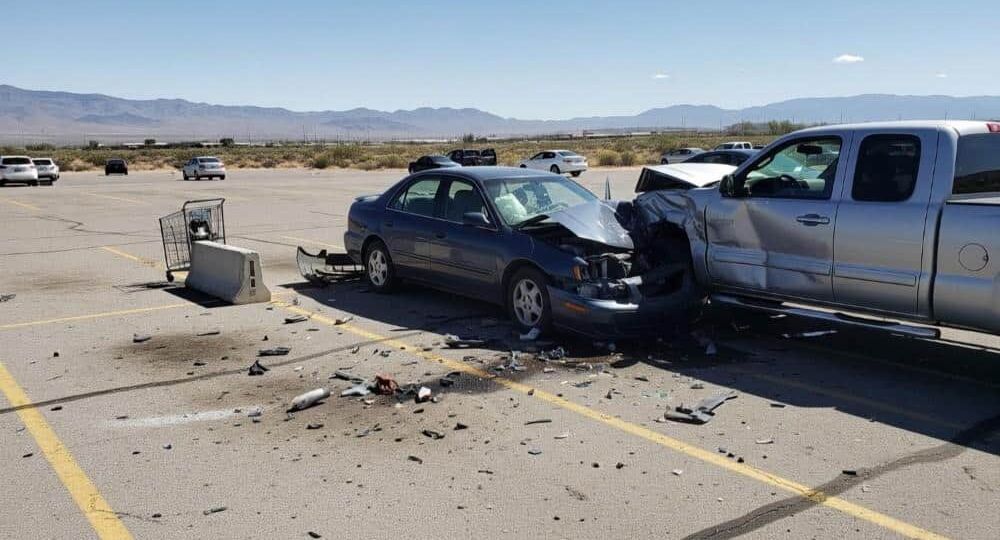
A parking lot crash at a Las Vegas casino, hotel, or shopping center can feel minor at first. The vehicles are often moving slowly, the damage may look limited, and both drivers may be eager to get inside or get home. However, even low speed collisions in crowded Strip garages, Fremont Street lots, and apartment complexes can cause neck and back injuries, concussions, and serious disputes about who is responsible. Nevada law does not treat these incidents as throwaway fender benders. The same fault based rules that govern crashes on I-15 and Sahara Avenue also apply inside private lots and garages in Las Vegas and across Clark County.
Many people hear that “parking lot accidents are always 50/50” and assume there is nothing they can do if the other driver or the insurance company repeats that phrase. That belief is incorrect under Nevada’s modified comparative negligence system. Fault depends on what actually happened, including who was backing, who had the right of way, and who ignored arrows, stop signs, or crosswalks. Before you decide whether a claim is worth pursuing, it is important to understand that Las Vegas parking lot accidents are not automatically split down the middle. The starting point is a clear answer to a common question.
Are Parking Lot Accidents Automatically 50/50 in Las Vegas?
The idea that all parking lot accidents are 50/50 is a myth. Nevada uses a modified comparative negligence system. Fault can be shared between drivers, and each person’s compensation is reduced by his or her percentage of fault. You are barred from recovering only if you are more negligent than the other driver or drivers combined.
Equal fault is just one possible outcome. Sometimes the evidence supports 50/50. Other times one driver is 10 percent at fault and the other is 90 percent at fault, or one driver is completely at fault. In a Las Vegas casino garage, for example, an adjuster might start by assuming that two cars backing at the same time are equally to blame. Camera footage, witness statements, and damage patterns can show that one driver backed out first and the other failed to keep a proper lookout.
What Happens if Fault Is Split in a Las Vegas Parking Lot Crash?
If fault is split, your compensation is adjusted by your share of responsibility. For example, if your total damages are 10,000 dollars and you are 20 percent at fault, your recovery would be reduced to 8,000 dollars. If your damages are 10,000 dollars and you are 60 percent at fault, you may recover nothing under Nevada’s comparative negligence rules.
The key point is that Nevada allows fault to be divided in many different ways, depending on what the evidence shows. Shared fault does not automatically mean 50/50, and it does not automatically eliminate your ability to recover.
Common Parking Lot Crash Scenarios and Who Is Usually at Fault
Insurers and courts do not decide parking lot cases in the abstract. They look at the specific scenario and ask who had the duty to yield, who failed to keep a proper lookout, who was backing versus driving through, and who ignored arrows, stop signs, or crosswalks. Right of way, safe backing, speed, and distraction all play roles.
In Las Vegas parking lots, these scenarios arise in casino garages, Strip surface lots, shopping center lots, and apartment complexes. Many lots have painted lane arrows, posted stop or yield signs, and marked pedestrian walkways. Violating these rules is often persuasive evidence in Nevada fault determinations. Here are a few common scenarios we see:
| Scenario | Usually at Fault | Key Evidence |
| Backing out of a space into a through lane | Backing driver | Photos of impact point, lane markings, vehicle positions |
| Two cars backing out of opposite spaces | Often shared between both backing drivers | Witness statements, camera footage, damage angles |
| Turning out of an aisle and failing to yield to through traffic | Turning driver | Stop or yield signs, arrows, witness accounts |
| Rear end collision in an aisle | Following driver | Vehicle damage, spacing, driver statements |
| Hitting a legally parked car | Moving driver | Location of parked vehicle, stall lines, impact area |
| Pedestrian struck in a marked crosswalk or walkway | Driver in most cases | Crosswalk markings, signage, surveillance video |
These are general patterns. Facts matter. The questions below address some of the most searched scenarios in more detail.
Who Is at Fault When Backing Out of a Parking Space and Hitting a Car?
A driver who backs out of a parking space must make sure the movement can be made safely and must yield to vehicles and pedestrians already moving in the through lane. Under Nevada rules regarding safe backing and starting from a parked position, a backing driver is usually at fault when he or she reverses into a moving car in a parking lot.
Evidence such as the angle of impact, location of damage, and photographs of the vehicles where they came to rest help confirm how far each vehicle moved and who entered the lane. Camera footage and witness accounts can also show whether the through lane driver was speeding or distracted, which can sometimes shift a small percentage of fault.
Who Is at Fault When Two Cars Back Into Each Other in a Parking Lot?
When two cars back out of spaces and collide, both drivers have duties as backing vehicles, and shared fault is common. The key questions are who began backing first, whether either driver could see the other, how fast each was backing, and whether any obstacles blocked the view. Equal fault is possible, but it is not automatic.
Camera footage, witness statements, and the pattern of damage often help adjusters and lawyers in Las Vegas allocate fault between backing drivers. In some cases one vehicle is barely beyond the stall while the other is far into the lane, suggesting a greater share of fault for the driver who moved farther without watching the lane.
Who Is at Fault if I Hit a Parked Car in a Las Vegas Parking Lot?
If you hit a legally parked vehicle inside a marked parking stall, you are usually at fault. You were the moving driver and had the duty to keep a proper lookout and control your speed. Striking a stationary car in a proper space usually indicates a failure to steer, brake, or pay attention.
There can be exceptions. If a vehicle is stopped in an aisle where it should not be, blocking traffic or hiding behind an obstruction, fault can shift somewhat. In hit and run situations where a driver damages a parked car in a Las Vegas lot and flees, uninsured motorist coverage may come into play if certain conditions are met. Misconceptions about no fault often arise after these crashes, so the next section explains why Nevada is not a no fault state, even for parking lots.
Is a Parking Lot Accident “No Fault” in Nevada?
Nevada is not a no fault state for car accidents. It uses a fault based system where the negligent party, or parties, is responsible for damages. Nevada law requires liability insurance for drivers to cover tort liabilities arising from the ownership or use of vehicles. There is no separate rule that turns parking lot collisions into no fault events simply because they occur on private property.
Being in a Las Vegas casino lot or a grocery store parking lot does not change this. Negligence rules apply to private parking lots and public roadways alike. Someone is still responsible, and that responsibility is decided under Nevada negligence law, not under a special “parking lot no fault” rule.
Are Parking Lot Accidents No Fault in Nevada?
Parking lot accidents are not no fault in Nevada. The same modified comparative negligence rules in NRS 41.141 apply whether the crash happens on Sahara Avenue or in a Strip garage. You still need to prove that the other driver, or drivers, failed to use reasonable care and that this negligence caused your damages.
Nevada policies may include an optional coverage that pays regardless of fault, which is where some confusion arises.
Does MedPay Cover Injuries in a Parking Lot Crash Regardless of Fault?
Medical payments coverage, often called MedPay, is an optional coverage that can pay medical bills up to the purchased limit regardless of who caused the crash. If you have MedPay on your Nevada auto policy, it can help with emergency room visits, urgent care, or follow up treatment after a Las Vegas parking lot collision, whether you were at fault or someone else was.
MedPay does not replace the fault based system. It is an add on that sits on top of it. You can still pursue a fault based claim against a negligent driver for pain and suffering, additional medical costs, lost wages, and other damages. Whether you have MedPay or not, you still need to prove fault, which can be challenging when police do not respond to parking lot crashes.
How Fault Is Proven When Police Do Not Respond to a Parking Lot Crash
In many Las Vegas parking lot accidents, police do not come to the scene, especially when there are no obvious injuries. Without a police report, your claim is built on the evidence you and the property collect at the scene. Good evidence can prevent an insurer from defaulting to “50/50” and can support your version of events.
Casino garages, Strip properties, malls, and larger complexes often have security cameras and private security staff. These can be crucial. However, camera footage may be overwritten quickly, sometimes in days, so identifying and preserving it early is important.
Useful evidence includes:
- Photos of vehicle positions before you move them, including angles and distances
- Close up photos of damage to each vehicle
- Photos of lane arrows, stop signs, yield signs, and crosswalks near the crash
- Contact information for the other driver and any independent witnesses
- Any incident report filed with property management or security
- Notes about lighting, weather, and visibility at the time of the crash
- Observations about visible cameras and their approximate locations
How Do You Prove Fault in a Parking Lot Accident Without a Police Report?
Without a police report, insurers rely on your evidence to reconstruct what likely happened. They look at who was stationary and who was moving, who was backing, where impact occurred, whether there were signs or arrows, and what witnesses say about speed and distraction. Strong, clear photos and witness accounts make it harder for an adjuster to claim that the crash must be 50/50.
A Las Vegas attorney can also send preservation letters to property owners, asking them to retain any surveillance footage that might show the crash. This can be critical in casino garages and large commercial lots where camera systems continuously record and overwrite.
Do I Have to File an SR-1 in Nevada if Police Did Not Investigate?
Nevada drivers generally must file an SR-1 crash report with the Nevada Department of Motor Vehicles within 10 days if there was no law enforcement investigation and the crash involved injury, death, or property damage above a certain threshold. The SR-1 form asks for basic information about the crash, the drivers, vehicles, and insurance companies.
Failing to file an SR-1 when required can create separate problems with your driver’s license and compliance. The SR-1 itself does not decide fault or compensation, but it adds to the paper trail for your Nevada parking lot claim. Once you have met your reporting obligations and gathered evidence, the next question is whether an insurance claim is enough or a lawsuit may be needed.
Can You Sue for a Parking Lot Accident in Las Vegas?
You can sue for a parking lot accident in Las Vegas when another driver or responsible party fails to use reasonable care and causes you harm. In practical terms, this means the other driver failed to yield, backed unsafely, drove too fast, failed to watch for pedestrians, or otherwise acted unreasonably, and that this negligence led to your property damage or injuries.
Issues like premises conditions and comparative negligence do not prevent you from suing. They influence who is named as a defendant and what proof you must present. A Las Vegas lawyer can help determine whether a lawsuit is appropriate in your specific case.
Can a Property Owner Be Liable for a Parking Lot Accident?
A property owner may be liable when the design or condition of a parking lot creates unreasonable hazards. Examples include poor lighting, missing or faded stop or yield signs, confusing or conflicting lane markings, blocked sight lines, or unsafe pedestrian routes that force people into traffic paths. In those situations, an injured person may have a premises liability claim in addition to a claim against the negligent driver.
Property owner liability is usually layered on top of driver negligence rather than replacing it. A casino, shopping center, or apartment complex might share responsibility with one or more drivers. A careful investigation is needed to determine whether premises conditions contributed to the crash.
When Does It Make Sense to File a Lawsuit Instead of Just an Insurance Claim?
Filing a lawsuit may make sense when injuries are serious, evidence of fault is strong but offers are low, fault is contested despite supportive evidence, the crash involves a hit and run with uninsured motorist issues, or a property owner denies obvious safety problems. A lawsuit can also be necessary when the statute of limitations is approaching and negotiations are not progressing.
Deadlines and evidence preservation are reasons not to wait too long. Most lawsuits still settle before trial, but filing preserves your right to continue seeking compensation.
Nevada Deadlines and Next Steps After a Las Vegas Parking Lot Crash
Even a strong parking lot accident claim can be weakened or lost if you miss Nevada deadlines or fail to report the crash properly. Nevada has specific timelines for filing lawsuits and for reporting certain crashes to the Department of Motor Vehicles. Out of state visitors injured in Las Vegas parking lots must still follow Nevada’s rules.
Most personal injury lawsuits arising from parking lot accidents must be filed within two years of the crash, and property damage only claims generally have three years. When police do not investigate, the SR-1 crash report requirement adds a much shorter deadline. Las Vegas Metropolitan Police may respond to some parking lot incidents, but when they do not, the SR-1 obligation usually falls on the drivers.
Key Nevada time rules include:
- Two years from the date of the crash for most injury lawsuits under NRS 11.190(4)(e)
- Three years for property damage only lawsuits under NRS 11.190(3)(c)
- Ten days to file an SR-1 crash report with the Nevada DMV when law enforcement does not investigate a qualifying crash
How Long Do I Have to Sue After a Parking Lot Accident in Nevada?
You generally have two years from the date of the crash to file a lawsuit for personal injuries and three years to file a lawsuit for property damage only claims in Nevada. Special circumstances can change these timelines, so it is important to speak with a lawyer early rather than guessing about deadlines.
Who Has the Right-of-Way at a Parking Lot Entrance or Exit in Nevada?
Drivers exiting a parking lot onto a public road must yield to traffic already on the road. Within a parking lot, drivers should follow posted stop and yield signs and painted arrows. Vehicles in main through aisles usually have priority over those leaving parking stalls or smaller feeder aisles, and drivers must watch for pedestrians in marked crosswalks and walkways.
Failing to yield at an entrance or exit is often a key factor in Las Vegas parking lot claims, especially where lots connect to busy streets. Adjusters will look at photos, signage, and witness accounts to decide who had the duty to yield.
What Should I Do Right After a Parking Lot Accident in Las Vegas?
Right after a parking lot accident, your first priority is safety. Move vehicles out of traffic if you can do so safely, and call 911 if anyone is injured or in danger. Even if injuries seem minor, consider getting checked out by a medical professional, because some injuries become more noticeable later.
There are also simple steps you can take to protect your rights and preserve evidence:
- Exchange names, phone numbers, driver’s license information, and insurance details with the other driver
- Take photos of the vehicles, damage, skid marks, lane arrows, signage, and the surrounding area before vehicles are moved if possible
- Look for witnesses and politely ask for their contact information
- Ask property management or security to prepare an incident report and request information about any cameras that might have captured the crash
- File an SR-1 crash report with the Nevada DMV if required because police did not investigate
- Report the collision to your own insurer, but be cautious about detailed recorded statements until you understand your rights
- Keep all documents and photos together and consider contacting a Las Vegas parking lot accident lawyer for advice on fault, coverage, and deadlines
Talk to a Las Vegas Parking Lot Accident Lawyer About Your Case
If you were hit in a Las Vegas parking lot, garage, or driveway and now an insurance adjuster is calling it “50/50” without looking at the facts, you do not have to accept that at face value. Drummond Law Firm can review photos, video, incident reports, SR-1 filings, and witness statements and help you understand how Nevada comparative negligence really applies to your situation, not just how an insurer prefers to see it.
If it Happened in Vegas, Call the Captain today at 702-CAPTAIN or reach out online to schedule a free consultation today. Schedule a free consultation with a Las Vegas parking lot accident lawyer who understands how fault, shared responsibility, and MedPay work under Nevada law. There is No Fee Until We Win, and with our Reduced Fee Guarantee our attorney fee will never be more than your net recovery.