When Does the Military Maintain Jurisdiction Over a Legal Matter?
Understanding which laws govern your case.
No one wants to find themselves in the situation where they are accused of a crime and need a criminal lawyer in Las Vegas. This is especially true for anyone that is in the military. It can be confusing right off the bat just trying to understand who has jurisdiction. And then there is the arrest and possible conviction that can significantly influence your military career in addition to the civilian legal penalties that you face.
Understanding Military Jurisdiction
Anyone that is on active duty or is undergoing inactive –duty training is under the Uniform Code of Military Justice (UCMJ). If a military member is active, in the reserves or retired, they can fall under the UCMJ and its guidelines. However, there is an exception for those serving in the Army National Guard or the Air National Guard. Unless they are performing their Federal service (they’ve been called up), they are not under the UCMJ. So essentially if you are in boot camp, advanced training, on active duty or reserve from active duty, you are held accountable under the UMJ.
Worldwide Jurisdiction
One of the most important things to note is that the Uniform Code of Military Justice has jurisdiction at home and abroad. It does not matter where you are stationed, that code governs. In fact, this is why a code is needed in the first place. Since U.S. citizens cannot be regulated by U.S. laws abroad, the military code creates consistency for service members regardless of where they are physically located.
Who Will Try You: Military or Civilian Court
This is where it can get complicated and why it is wise to have an attorney that can handle your case both ways. As a civilian and military lawyer, Craig Drummond can represent you in both civilian and military courts. A former Captain in the U.S. JAG Corps, he understands military law, how it is interpreted and how it is applied so that you can receive the strongest possible defense. If the crime in question is specific to the military (compromising the mission etc.) you will be tried in military court without question. If, however, you are accused of committing a crime that is applicable to anyone, you could be tried in military court, civilian court or both. Typically speaking, you could have charges brought against you by both courts and they would then coordinate to determine who will prosecute you.
Warning: If you are tried in civilian court, your case is not over once a verdict is levied. You could still be punished by the military, even if the charges were dropped. Most civilian lawyers would have no understanding of how to handle this situation so you need an attorney who can handle both. A perfect example would be someone arrested and tried for a DUI in civilian court. The charges could be reduced to reckless driving but the military could still impose fines, require mandatory treatment, etc., regardless of what the civilian court does.
 Great news! If you feel that there is a conflict of interest with your insurance company, you can hire an independent attorney to represent you and ask them to pay for it. There are certain factors that must be present in order to qualify for this, but if you feel that your insurance company is not treating you fairly or if you think something feels strange or off with your legal representation, you should consult with an independent lawyer and discuss your case.
 If you have filed a Nevada injury case and are thinking about filing for bankruptcy, don’t do it without speaking with your injury attorney. Filing for bankruptcy can and will impact your pending case, so it is important to have a strategy in place that will protect your assets. If you have already filed for bankruptcy, let your injury attorney know quickly so they can work with you to adjust plans as necessary.
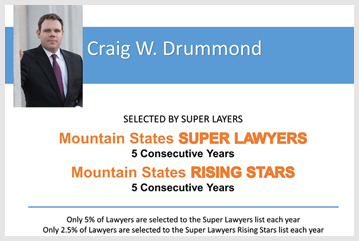 Super Lawyers has once again named Attorney Craig Drummond to their Top Laywers list as a “Rising Star” in the Mountain States. No more than 5% of Attorney’s are selected for inclusion to Super Lawyers and only the top 2.5% are selected as Rising Stars. This is Craig’s 5th consecutive year of receiving this award.